🥘 Ingredients
To Make the Udon Dough
-
all-purpose flour200 g
-
salt10 g
-
water90 ml
To Roll Out the Dough
-
potato starch or cornstarch
🍳 Cookware
- bowl
-
📝
Note that this recipe requires 2 1/2 hours of resting time.
To Make the Udon Dough
-
1Add salt to water and stir until it’s completely dissolved.salt: 10 g, water: 90 ml
-
2Place all-purpose flour in a large bowl . Gradually distribute the salted water evenly across the flour while mixing with your hands or with a stand mixer. This way, salt doesn’t concentrate into one part of the dough.all-purpose flour: 200 g
-
3Combine the dough until there is no dry flour left. Then, form it into a ball.
-
4If there is some dry flour left, add only a very small amount of water needed to hydrate the flour. Important: The dough should be really tough, unlike bread dough. Try your best to avoid adding water unless you have a really hard time pressing the dough into a ball. Again, use as little water as possible.
-
5Place the dough ball in a large durable ziplock bag or covered container.
-
6Leave a small air gap and let it rest for ⏱️ 30 minutes to relax the gluten.
Manual Kneading
-
📝
See next section if using a stand mixer
-
1To keep your dough and the bag clean while kneading, place the bag between two kitchen towels on the floor.
-
2Step on the bag with the dough inside using the heels of your feet. Use your weight to flatten it, slowly turning 360 degrees as you stretch out the dough from the center to the edges. Continue to step on the dough until it is stretched out and completely flat. Tip: You can knead with your hands instead, but it will take more effort and time. Stepping on the udon dough is a common practice in Japan!
-
3Remove the dough from the bag and fold in the edges toward the middle.
-
4Collect the edges in the center of the dough and flip it over so the seam side is facing down.
-
5Press and rotate the dough with cupped hands to form it into a ball.
-
6Place the dough ball back into the bag and close the bag, leaving a small air gap. Repeat the dough kneading or “stepping“ process from Step 2. You can see if you are stepping on the right location to flatten the dough by occasionally lifting the towel to check.
-
7Continue stepping on the dough until it is stretched flat.
-
8Remove the dough from the bag and fold the edges toward the center, flip it over, and form it into a ball again.
-
9You will notice that the dough is slightly more pliable than the first time.
-
10Repeat this process three more times for a total of five rounds of dough stepping, or until the dough is as soft as an earlobe (that’s how we describe the texture of the finished udon dough in Japan).
-
11After the fifth round of dough stepping, take out the dough and form it into a nice, round ball. Put the dough back into the bag and close.
Kneading with Stand Mixer
-
1Knead on low with a douch hook until the dough is as soft as an earlobe.
-
2Take out the dough and form it into a nice, round ball. Put the dough into a bag and close.
To Rest the Dough
-
1Rest the dough on the kitchen counter for ⏱️ 120 minutes (3 hours in the wintertime). You can also keep the dough in the bag and store it in the refrigerator overnight if you would like to continue the rest of the process on the following day.
To Roll Out the Dough
-
1Dust the work surface with potato starch or cornstarch and take out the dough from the bag.potato starch or cornstarch
-
📝
It‘s especially important to use potato starch or cornstarch if you plan to freeze the noodles since the noodles tend to absorb wheat flour, which causes them to stick to each other.
-
2Flatten the dough with your hand.
-
3Using a rolling pin, first roll out the dough into an oval shape. Then, turn the dough 90 degrees and roll it out evenly in the other direction.
-
4Then, roll out the corners to create a rectangular shape.
-
5Dust the dough with potato starch or cornstarch occasionally to make sure the dough does not stick to the rolling pin or the work surface.
-
6Turn the dough 90 degrees and roll out the dough more.
-
7The dough should be about 3 mm (1/8 inch) thick and about 10–12 inches long.
-
8Roll out each rounded corner so the dough forms a rectangle. This will allow the noodles to be the same length when you cut them.
-
9Dust more potato starch on top of the dough and spread it thinly.
-
10Fold the dough in half or thirds and sprinkle more potato starch on top.
To Cut into Noodles
-
1With a sharp knife or cleaver, cut the folded dough into noodles about 3 mm (1/8 inch) wide.
-
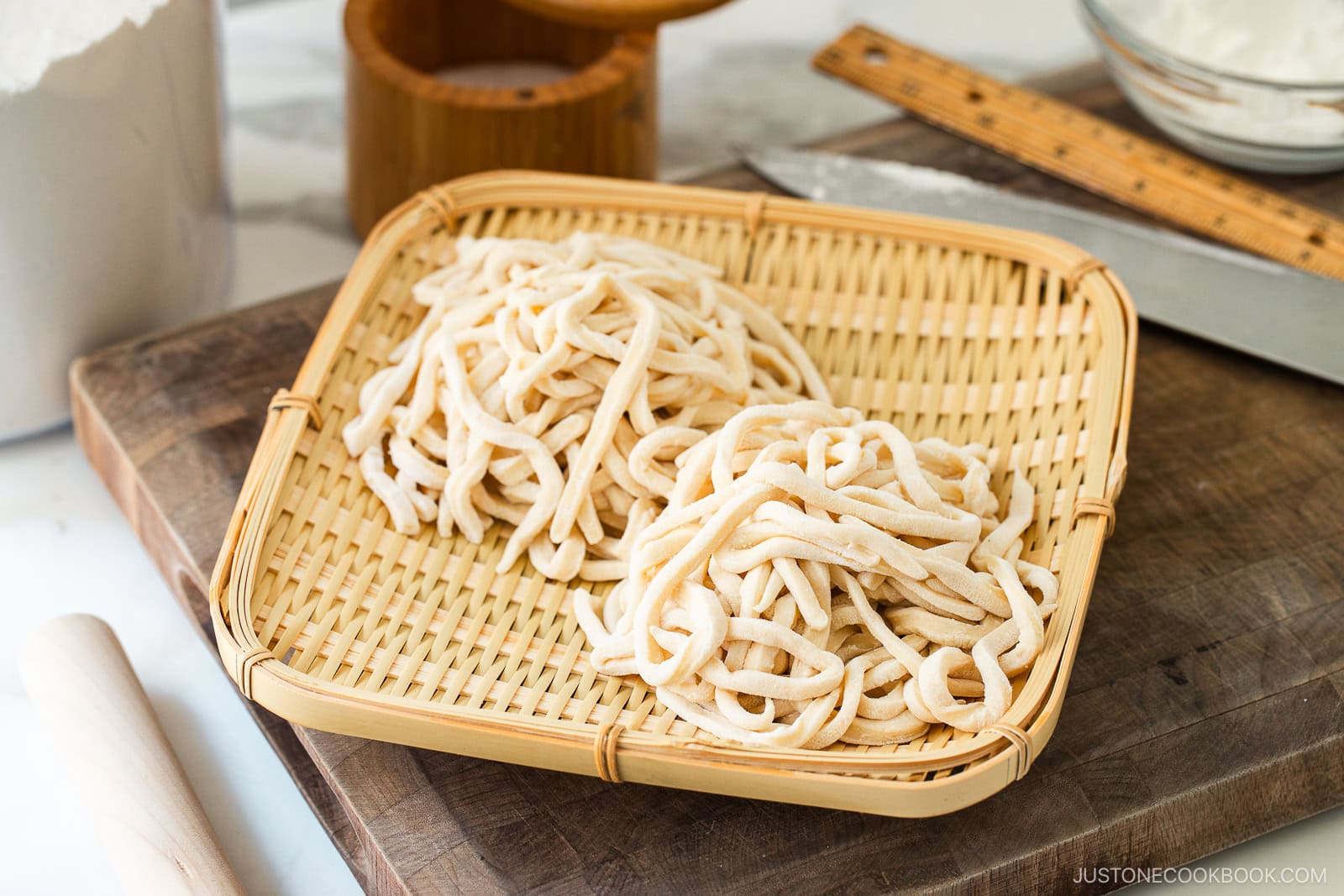
2Pick up some of the noodles and fluff them with your fingers to make sure they are covered with the potato starch/cornstarch to prevent them from sticking to each other. The noodles are ready to cook now or freeze for later.
To Cook the Fresh Noodles
-
1Bring a big pot of unsalted water to a rolling boil (DO NOT add salt to the water; the noodles are already seasoned and will release some salt during cooking). Loosen up the noodles, leaving the excess starch behind, and add the noodles to the pot.
-
2Cook, stirring occasionally, for about ⏱️ 10 minutes (depending on the thickness of your noodles).
-
3Drain and rinse well under cold running water to remove the starch and give the noodles a firm texture. The noodles are now ready to use in your favorite udon recipe.
To Serve the Cooked Noodles
-
1For hot noodle soup, you can quickly heat up the cooked noodles either in a pot of hot water or under hot running water. Serve in individual bowls and pour soup broth on top.
-
2You can also enjoy these udon noodles in stir-fries like Yaki Udon, refreshing chilled dishes like Cold Tanuki Udon and Cold Curry Udon, the finishing course of a Sukiyaki meal, and wafu pasta-style Mentaiko Udon.
To Store the Fresh Noodles for Later
-
1Divide the uncooked noodles into individual portions (150 g each) and freeze in an airtight container or bag for up to a month. You can refrigerate it for a few days, but it tastes better when you freeze the fresh udon right away. To cook from frozen, bring a large pot of water to a boil and cook the frozen udon for ⏱️ 12 minutes without defrosting. Drain and rinse well under cold running water to remove the starch. For hot noodle soup, you can quickly heat up the noodles in a pot of hot water or warm them up under hot running water.